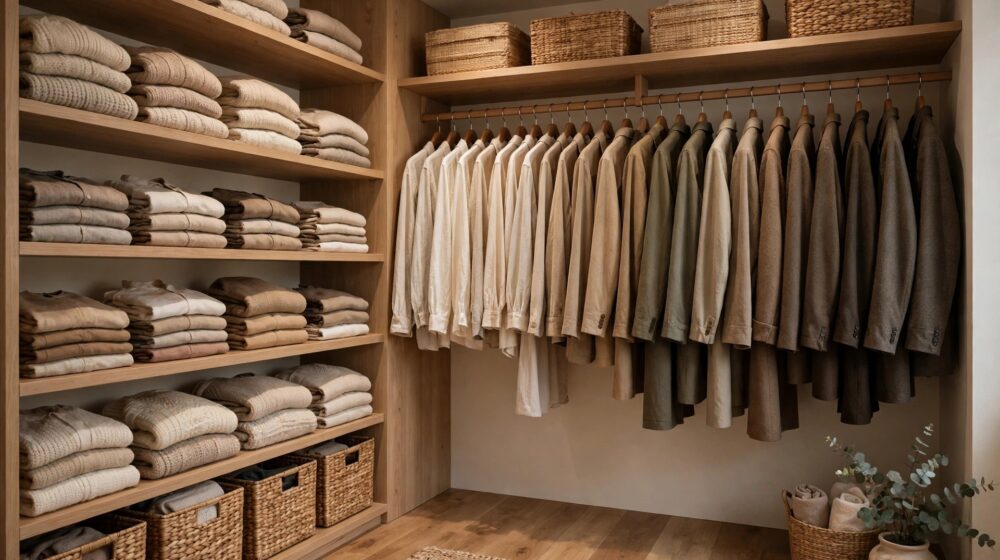
Most closet organization systems fail within a month. Not because the system was bad, but because it was built for the wrong wardrobe. It was built for the clothes you wish you wore, arranged the way a magazine would arrange them, in a closet that does not match your life.
A system that lasts is built the other way around: for the clothes you actually wear, in the order you actually reach for them, with space for the mess real life makes.
Step 1: The wear test
Before you buy a single organizer, find out what you actually wear. Turn every hanger backwards. Each time you wear something, hang it back the normal way. After thirty days, everything still backwards is something you have not worn in a month.
Be honest about the result. The clothes you have not worn in a month fall into three groups: out of season, wrong size, or simply not your style anymore. Out of season goes into storage. The other two go out of the closet entirely, to donation, resale, or a friend.
Most people discover they wear about twenty percent of their closet eighty percent of the time. The system you build should serve that twenty percent first.
Step 2: Zone the closet by use, not by type
Closets organized by type, all shirts together, all pants together, look tidy and work poorly. You do not get dressed by type. You get dressed by occasion.
Zone the closet by use instead:
- Everyday: The clothes you reach for on a normal day, at eye level, easiest to grab.
- Work: Work outfits together, so a weekday morning takes one reach, not five.
- Occasion: Dressy clothes, outerwear, and seasonal items, higher up or further back.
- Active and lounge: Together, lower down, because you change into them at home.
Within each zone, order by color, light to dark. It looks calm, and it makes finding a specific item fast. The zones do the organizing; the color order does the looking good.
Step 3: Fold what should be folded, hang what should be hung
Heavy knitwear, T-shirts, and jeans last longer folded. Blouses, dresses, trousers, and jackets last longer hung. Folded knitwear keeps its shape; hung knitwear stretches at the shoulders.
Use matching hangers. It sounds fussy and it matters more than any organizer. Mixed hangers, wire, plastic, wood, all different heights, make even a tidy closet look chaotic. Slim velvet hangers take up less space, grip clothes so they do not slide off, and make the whole rail look calm. One set of matching hangers is the cheapest closet upgrade there is.
For folded clothes, file fold instead of stacking. Fold each item into a rectangle and stand it upright in a drawer or basket, like files in a drawer. You can see everything at a glance, and taking one item out does not collapse the whole stack.
Slim velvet hangers, pack of 50
The single cheapest closet upgrade. Matching slim hangers free up rail space and stop clothes sliding onto the floor.
Choose one color and one style for the whole closet so the rail looks calm.
Affiliate link: Check current price
Affiliate link. We may earn a commission if you buy through this link, at no extra cost to you. See our Affiliate Disclosure.
Step 4: Give everything a visible home
A closet stays organized when every category has a visible, obvious home. Shoes on a low rack or in clear boxes, not in a pile. Bags on hooks or a high shelf, not on the floor. Accessories in small trays or a hanging organizer, not in a drawer you never open.
Baskets and boxes work when they are labeled and shallow. A deep, unlabeled basket is a black hole where things go to disappear. A shallow basket with a label, scarves, belts, swimwear, is a home. If you cannot see what is inside without digging, the container is too deep.
Leave ten percent of the closet empty. A closet packed to the edges cannot stay organized, because there is nowhere to put the thing you just took off. Empty space is not wasted space. It is the breathing room that keeps the system working.
The weekly reset
A closet system needs five minutes a week, not a full reorganization every season. Pick one day, Sunday evening works well, and do three things: hang up anything draped over a chair, return anything borrowed to its zone, and pull out one item you have not worn in a month for the donation bag.
Five minutes a week beats five hours every season. The system does not need to be perfect. It needs to be easy enough to maintain on a tired Sunday evening, because that is when it will be tested.
A note on sources
These ideas reflect widely published home organization guidance and storage manufacturers' published advice on closet layout and garment care. Closet dimensions and wardrobe sizes vary, so measure your own space before buying organizers.